
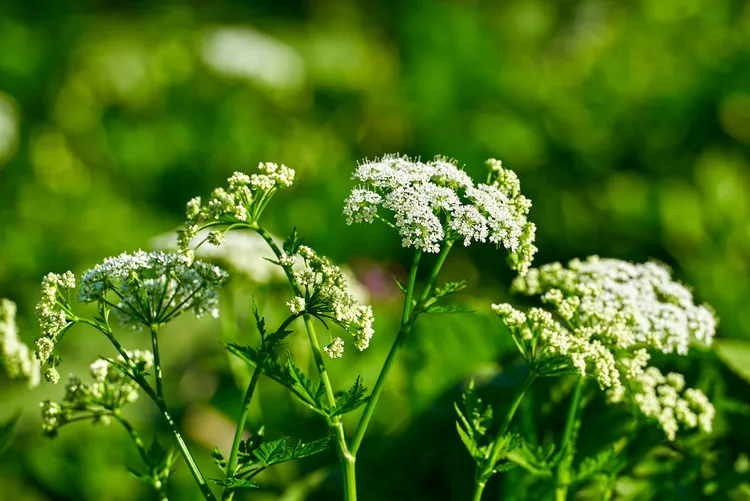
Removing weeds from your yard can feel like a never-ending battle, but it's key to keeping your lawn and garden looking their best and your plants healthy. In some cases, those weeds can impact your own health as well. You may already be familiar with certain dangerous plants to avoid, like poison ivy, but right now it's poison hemlock that's grabbing our attention. Recently, populations of this toxic and invasive plant have been exploding in parks and gardens across the country. It thrives in moist soil and the flooding the country has been experiencing has played a part in its unprecedented growth. Every part of poison hemlock is highly toxic to humans, livestock, and other animals, including your dog or cat.
As poison hemlock spreads, there's "more of an opportunity for kids to play with it and pets to eat it," Dan Shaver, a state forester for the Natural Resources Conservation Service in Indiana, tells The Indianapolis Star. "It is not a plant you want around your home or in your local park."
What is Poison Hemlock?
Native to Europe, poison hemlock (Conium maculatum) is a relative of carrots and parsley that was brought to North America in the 1800s as an ornamental plant because of its ferny leaves. Since then, the plant has spread itself around nearly every part of the U.S., according to the National Park Service. Poison hemlock prefers moist, shady spots and is quick to invade disturbed areas, such as recently tilled ground. You may find it popping up along roadsides, ditches, meadows, and other wild areas.
Poison hemlock is a biennial, which means that in its first year it produces only leaves. In its second year, this weedy plant comes back after the winter from its roots to bloom and produce thousands of seeds before dying. The seeds usually fall from the plant from September through December but can drop as late as February.
How to Identify Poison Hemlock
One reason poison hemlock is such a public health problem is that the plant looks similar to Queen Anne's lace (Daucus carota) or wild carrot, a common wildflower that is harmless. The white blooms of Queen Anne's lace are often picked for bouquets and the leaves are even edible. Confusing the two plants can have deadly consequences.
Poison hemlock has a few characteristics you can use to tell it apart from Queen Anne's lace. Overall size can give you your first clue. Poison hemlock can grow anywhere from 2 to 10 feet tall, but Queen Anne's lace stays shorter, between 2 to 3 feet. Next, take a look at the stems. Poison hemlock has smooth, hairless, hollow green stems that usually have purple spots and streaks. Queen Anne's lace has hairy, solid, green stems and no spots.
The white, umbrella-shape blooms look very similar on both plants, except for a few subtle differences. The flower clusters of Queen Anne's lace tend to have a flatter shape, plus there is often a single darker flower in the center of the cluster and the older blooms curl up and inward, like an inside-out umbrella. It's also tough to tell which plant you're dealing with when looking at the green, fern-like leaves, but those of poison hemlock have a musty, unpleasant odor when crushed; Queen Anne's lace foliage has a carrot-like scent.
There are a few other lookalike plants to poison hemlock besides Queen Anne's lace, such as wild parsnip and water hemlock (both of which are also dangerous if touched or eaten), so if you have any doubt, it is best to steer clear if you can.
How to Safely Remove Poison Hemlock
If you find poison hemlock that needs to be removed, be extremely careful around it. Chemicals in this plant can affect the central nervous and respiratory systems, according to the University of California Agriculture & Natural Resources website, and is potentially lethal when ingested, even in very small amounts. The United States Department of Agriculture notes that the plant can also cause some individuals to break out in a burn-like rash upon contact, so always wear protective clothing, including long pants, a long-sleeved shirt, sturdy shoes, safety glasses, and gloves when dealing with poison hemlock.
The USDA details a variety of ways to get rid of poison hemlock, with options for physical, cultural, biological, and chemical controls. Your best bet is to get the plant under control when the spread is small. If you're dealing with an infestation that's larger than you feel safe handling, contact your local Natural Resources Conservation Service for instructions and assistance.