
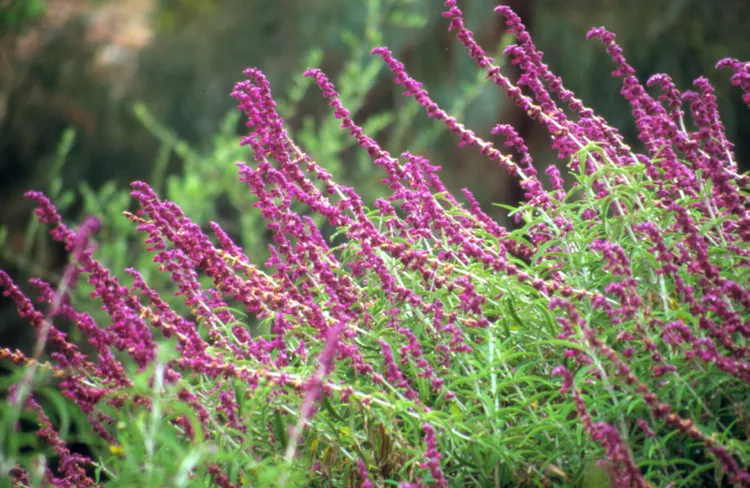
Xeriscape plants need little to no supplemental water in a landscape, and generally are undemanding when it comes to maintenance. But xeriscape doesn't mean your yard has to look like a desert. Depending on the plants you choose, a xeriscape garden can be lush, colorful, and vibrant. The list of xeriscape plants below includes drought-tolerant perennials, shrubs, grasses, succulents, and more that will fill your landscape with color.
What Is Xeriscaping?
Xeriscaping is a type of garden design that requires little to no additional water other than natural rainfall. Although it tends to be most popular in arid regions, xeriscape gardening works anywhere that experiences drought because it's about making smart choices when designing, selecting plants, and caring for water-wise garden. It's important not to confuse this concept with zeroscaping, which uses few (or zero) plants. A zeroscape is primarily gravel, large stones, dirt, and other non-living elements, requiring “zero” water.
Principals of Xeriscaping
Xeriscape gardening is all about conserving water and reducing landscape maintenance. It was coined in 1981 by Denver Water and includes seven principles:
- Plan and design the landscape.
- Evaluate the soil and improve it if needed.
- Limit turf grass.
- Group plants with similar water needs.
- Water efficiently, and irrigate only when necessary.
- Use organic mulch to retain soil moisture and reduce weeds.
- Properly maintain your landscape.
Best Xeriscape Plants
Depending on your yearly rainfall and summer and winter temperatures, not all of these plants may be suitable. And because a plant that's ideal for one region may be too rambunctious or invasive in another part of the country, always check local recommendations before adding any plant to your garden.
Blazing Star
There are more than 40 different species of blazing star, native from Ontario down through Texas. Many are quite drought tolerant, with some, such as Texas blazing star (Liatris mucronata), surviving on less than 10 inches of rain annually. Most have upright purple flower spikes, although ‘Floristan White’ dense blazing star (Liatris spicata) is occasionally available at garden centers. They range in size from 1-6 feet tall, although most are 2-4 feet tall. Most blazing stars grow best in full sun, although they can tolerate light shade.
Lantana
Lantana (Lantana camara) is a fast-growing perennial in USDA Hardiness Zones 8-11 and a heat-loving annual where it is not winter hardy. It's covered in numerous clusters of flowers ranging from white and gold to pink, purple, red, and even multicolor throughout the warm season. Plant it in full sun and well-drained soil for the best flowering display.
Alliums
Alliums, also called flowering onions, are available in a multitude of sizes and colors, although pink/purple is most common. For example, nodding onion (Allium cernuum, shown here) is a North American native with downward-facing, delicate pale pink flowers. Most alliums require full sun and well-drained soil to thrive in the landscape. Hardiness varies depending on species, but most will grow in Zones 4-8.
Yarrow
Yarrow (Achillea spp.) is a popular perennial for drought-tolerant and xeriscape gardens. Achillea millefolium is native throughout most of the United States and has white or off-white flowers. However, yarrow can be found in shades of yellow, pink, orange, white, and red. Grow this plant in full sun and cut it back to the ground once it has bloomed to encourage another round of flowering.
Blue Grama Grass
The horizontal seed heads of blue grama grass (Bouteloua gracilis) impart a unique horizontal texture to the late summer and autumn garden. Blue grama grass is native to North America and grows about 2 feet tall. It does best in fast-draining soil in full sun to light shade, and is hardy in Zones 4-9.
Daffodil
Although the cheery yellow or white spring flowers of daffodils (Narcissus spp.) may look delicate, these plants are actually very drought-tolerant. In fact, they do best planted in an area that stays dry during the summer. Wet soil can cause the bulbs to rot. Try planting daffodil bulbs underneath trees that lose their leave in winter. By the time the new leaves emerge on the trees, the daffodils should finished blooming, and the roots of the trees will help keep the soil around the bulbs dry.
Texas Mountain Laurel
Texas mountain laurel (Dermatophyllum secundiflorum syn. Sophora secundiflora) is a small to mid-sized evergreen tree with clusters of fragrant purple flowers that resemble wisteria. Hardy in Zones 8-11, it is an excellent option for gardeners throughout the South and the West Coast. It can tolerate less than 10 inches of rain annually but will perform better with additional water. Regardless, it will survive on rainfall alone.
Agave
Agaves add structural elegance to a xeriscape. They range from less than 1 foot tall and wide, to massive. Agave havardiana can grow up to 4 feet wide. Most agave are only cold hardy to Zone 7. However, some are reliably hardy to Zone 5, provided they are dry throughout winter. Agave can be grown in pots, although large specimens become very heavy and challenging to lug around.
Choose a planting location for agaves carefully to avoid too much proximity with the exceptionally sharp needles at the end of the leaves. They can easily puncture clothing and gloves. Some gardeners prefer to clip off the needles for safety reasons.
Lady Banks’ Rose
Lady Banks’ rose (Rosa banksiae) is a large, rambling rose that can quickly grow up to 20 feet long. Small double flowers cover the plant in spring; white and yellow forms are available. Lady Banks’ rose will thrive even in intense summer heat and drought conditions. Native to China, this excellent rose is thornless and looks especially stunning draped on a large fence or across the top of a brick wall.
Little Bluestem
Little bluestem (Schizachyrium scoparium) is a modest-sized (2-3 feet tall, 1-2 feet wide) ornamental grass that's native to the continental United States. It forms tight, upright clumps. Once established in the garden, it rarely, if ever, needs extra water. It stays upright and looks lovely throughout winter in areas with moderate snowfall. Cut it back to the ground in late spring to allow the new growth to emerge.
Texas Sage
Texas sage (Leucophyllum frutescens) is a mid-sized shrub, reaching 6-8 feet tall and 4-6 feet wide. This plant, also called cenizo, thrives in hot and dry conditions but cannot tolerate wet soil. It can be sheared into a formal hedge or shaped into a ball. The pink/purple flowers shine bright against the unique silvery-green to-gray leaf color, which provides an exciting contrast in the landscape in Zones 8-10.
Salvia
There is a salvia for almost every color in the rainbow. Some are grown as seasonal annual flowers, and others are perennials. Many, such as Salvia greggii, grow like miniature flowering shrubs and can tolerate dry, rocky soils in full sun. Others have attractive leaves and beautiful flowers, including Mexican bush sage (Salvia leucantha, shown here) and pineapple sage (Salvia elegans).
Southern Wax Myrtle
Southern wax myrtle (Myrica cerifera syn. Morella cerifera) grows 6-12 feet tall or more, and has attractive olive-green foliage. Female plants produce pale-blue berries in winter. Left unpruned, this plant develops a billowing cloud-like form. ‘Don’s Dwarf’ is, as the name suggests, a compact form, growing 2-6 feet tall and wide. It can tolerate drought but will perform best in areas that receive regular rainfall.
Muhly Grass
There are many types of muhly grass popular with xeriscape gardeners, including pink muhly (Muhlenbergia capillaris, shown here), rose muhly (Muhlenbergia reverchonii), and Lindheimer’s muhly (Muhlenbergia lindheimeri). These three, as well as many others, are native to North America. The cold hardiness of muhly grasses ranges from Zone 5 (rose muhly) to Zone 7 (pink muhly and Lindheimer’s muhly). Pink muhly features a profuse amount of pink plumes each summer. Rose muhly looks similar but is shorter and able to grow in somewhat wetter conditions than pink muhly. The flowers of Lindheimer’s muhly are less open and airy but no less beautiful. They are closer to white with a tinge of pink.
Lavender
Lavender (Lavandula spp.) is often grown as an aromatic herb but it's also a heat-loving, drought-tolerant superstar in the ornamental garden where its attractive flowers shine. Many different lavenders are available to gardeners, but all require full sun and well-drained soils. Hardiness varies depending on species but most are hardy in Zones 5-9.
Yaupon Holly
Yaupon holly (Ilex vomitoria) is a native evergreen type of holly that can be pruned as a formal hedge or left to grow naturally into a loose, upright evergreen shrub or small tree. It handles full sun, part shade, drought, and moist soils. It can be grown in full shade, although the growth will be less dense. Female plants produce red berries that feed birds and other wildlife. It is fast growing, up to 2-3 feet per year, and can be used as a screen or hedge. ‘Pride of Houston’ is a noteworthy female plant with thousands of red berries each season.
Purple Lovegrass
Purple lovegrass (Eragrostis spectabilis) is a North American native grass that grows in sandy and compacted soils. In late summer, the flower panicles rise above the low foliage, creating waves of purple clouds floating above the plant. It is hardy in Zones 5-9. It is similar in appearance to pinky muhly grass but stays shorter.
Red Yucca
Despite its common name, red yucca (Hesperaloe parviflora) is not a true yucca. Tall flower stalks with coral-red flowers dangle over the coarse grass-like foliage. The leaves are grayish-blue to green, giving the garden an interesting rigid texture. Grow red yucca in full sun and well-drained soil. This xeriscape plant is hardy to Zone 5 as long as the roots stay dry throughout winter.
Four O’Clocks
True to their name, the fragrant flowers of four o’clocks (Mirabilis jalapa) open in the late afternoon, and occasionally earlier on cloudy days. They are remarkably drought tolerant but are not reliably hardy if temperatures get below freezing. They produce a lot of seeds, however, and will reappear the following spring. The most common variety has bright pink flowers, although there are also orange, white, yellow, and red selections.
Spineless Prickly Pear Cactus
The word “cactus” may make you think of prickly plants, but spineless prickly pear (Opuntia ellisiana) is an exception. It has all the architectural beauty of prickly pear cacti without the vicious pointy parts. It is hardy to Zones 7-10, and the yellow flowers are a bonus. Grow prickly pear cactus in a fast-draining area, such as a gravel garden.
Yucca
Yuccas may look they would only survive in a desert, but some types are hardy down to Zone 4. They will not, however, grow in wet soils, or especially frigid, moist soils in winter. This makes them ideal for the xeriscape garden. ‘Color Guard’ yucca (shown here) has green leaves edged in yellow, making it a striking focal point in the garden.