
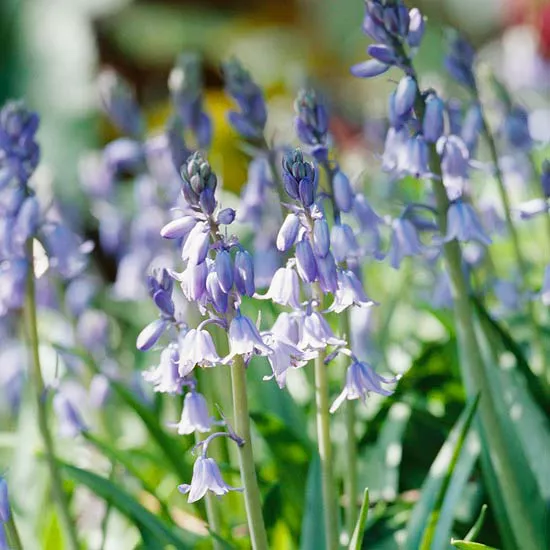
With strappy leaves and clusters of elegant lavender-blue flowers, Spanish bluebell blossoms dangle from spikes, adding a casual look to garden beds or borders. These pendant-style bells flourish under trees or shrubs or in shady borders, where early spring color is at a premium. Spanish bluebells have a loose, informal growth habit and a more delicate appearance than their cousins, the hybrid hyacinths. When they’re happy, these cheerful little bulbs can self-seed abundantly, forming large colonies in just a few years. They make delightful companions for early-blooming perennials and shrubs such as hellebore and azalea.
All parts of the plant are toxic to humans and pets.
Spanish Bluebell Overview
| Genus Name | Hyacinthoides hispanica |
| Common Name | Spanish Bluebell |
| Additional Common Names | Wood Hyacinth |
| Plant Type | Bulb |
| Light | Part Sun, Sun |
| Height | 6 to 18 inches |
| Width | 10 to 12 inches |
| Flower Color | Blue, Pink, White |
| Foliage Color | Blue/Green |
| Season Features | Spring Bloom |
| Special Features | Fragrance, Low Maintenance |
| Zones | 3, 4, 5, 6, 7, 8 |
| Propagation | Division |
| Problem Solvers | Deer Resistant |
Where to Plant Spanish Bluebell
Plant them in well-drained, slightly acidic to neutral soil and watch them take off. Because Spanish bluebells don't mind sun or part shade, you can plant them practically anywhere in your yard.
As the plants go fully dormant by midsummer, they are ideal for growing beneath deciduous trees like oaks and maples or at the base of deciduous shrubs such as rose of Sharon or roses to add color as the shrubs begin to leaf out in spring. They flourish in shady plantings alongside other spring-blooming bulbs. Spanish bluebells look right at home in woodland gardens, too—and they're charming companions for ferns, columbines, and other shade-loving favorites.
Plant them on their own or in clumps or mix them with other spring-blooming perennials. For a more natural look in a woodland setting, scatter the bulbs in small clumps with irregular spacing. Grow them with plants that fill out over the summer to prevent empty bare spots in your beds and borders.
Because Spanish bluebells spread fast through rhizomes and by reseeding, they can take over a landscape. They are considered invasive in the Pacific Northwest and in the United Kingdom, where they are endangering the native English bluebells.
How and When to Plant Spanish Bluebell
The best time to plant Spanish bluebells, like most other spring-blooming bulbs, is in early fall as soil temperatures begin to cool but early enough so the roots can get established before the ground freezes.
Plant the bulbs 4 inches deep and 4 inches apart, with the pointed growing tip facing upwards.
Spanish Bluebell Care Tips
Light
Spanish bluebells are an easy-care spring-blooming bulb that does best in full sun (at least six hours of direct sun per day) or part shade. While they tolerate all-day shade, they don't tend to bloom as well.
Soil and Water
These plants are not fussy about soil type, but they bloom best and spread fastest in soil that's moist, well-drained, and rich in organic matter. Avoid soil that has a high clay content; in soggy soil they have a tendency to rot out and die over the summer.
Temperature and Humidity
Spanish bluebells are hardy bulbs. In their native habitat, Spanish bluebells grow in cool, shady, damp, well-drained woodlands. While they are adaptable to different growing conditions, they don’t do well in hot climates. High humidity during the summer usually does not affect them as the plants go dormant by midsummer.
Fertilizer
Other than amending the soil with well-aged manure or compost on a yearly basis, there is no need to fertilize Spanish bluebells.
Pruning
After they finish flowering, the foliage will begin to go yellow and die off. At that point, you can remove it. That also means no mowing while the foliage is still green, as it will deprive the plants of their ability to gather energy for next year's bloom.
What you can do, though, is cut the spend flowerheads immediately after the bloom to prevent the plant from self-seeding.
Potting and Repotting Spanish Bluebell
Like other perennial spring bloomers, Spanish bluebells are not a good choice for growing in containers. In garden soil, the bulbs are insulated from the summer heat and winter cold, in containers, on the other hand, they are exposed to extreme temperatures and frequent temperature fluctuations, including cycles of freezing and thawing, which is detrimental to the bulbs.
Pests and Problems
Spanish bluebell is a worry-free plant, not prone to serious pests and diseases, and unbothered by deer and rodents. The only issue can be root rot in soil with poor drainage.
How to Propagate Spanish Bluebell
Spanish bluebells are propagated through division. In the late summer or early fall, dig up the bulbs. It helps to mark their exact locations after their bloom and before the foliage disappears.
Separate the overcrowded old and new bulbs. Discard any blemished and diseased bulbs and replant the new bulbs 3 inches deep and 4 to 6 inches apart.
Types of Spanish Bluebell
Excelsior Blue
Hyacinthoides hispanica ‘Excelsior’ is a cultivar with dainty blue flowers.
Dainty Maid Pink
Not all Spanish bluebells are blue—Hyacinthoides hispanica ‘Dainty Maid’ has pink flowers.
White City
There is also a variety with snow-white flowers, Hyacinthoides hispanica ‘White City’.
Companion Plants
Bleeding Heart
The old-fashioned bleeding heart is truly an easy-to-grow perennial. It is quick to pop up alongside spring bulbs and swiftly grow to full size. The leaves are generally a pleasant blue-green or gold, and its heart-shaped blossoms can come in a range of colors, including pink, red, white-reds, and white. Zone 3-9
Hellebore
Hellebores are so easy and so pretty, they have a place in nearly every landscape. Their exquisite bowl- or saucer-shape flowers in white (often speckled), pinks, yellows, or maroon remain on the plant for several months, even after the petals have fallen. Grow hellebores in shade where soil remains moist; some hellebores prefer acid or alkaline conditions, depending on the variety. Zone 4-9
Lungwort
This perennial with pretty spring blooms comes in a variety of colors. The blooms of lungwort fade beautifully in color, starting as a lovely shade of red; as they age, they become rich purple. These plants work well with other shade plants and add brightness to dark corners of the garden. Zone 2-8
Daffodils
Plant Spanish bluebell with daffodils as they bloom at the same time and like similar conditions. Yellow daffodils provide a stunning contrast to lavender-blue Spanish bluebell; white daffodils blend harmoniously. Zone 3-9