
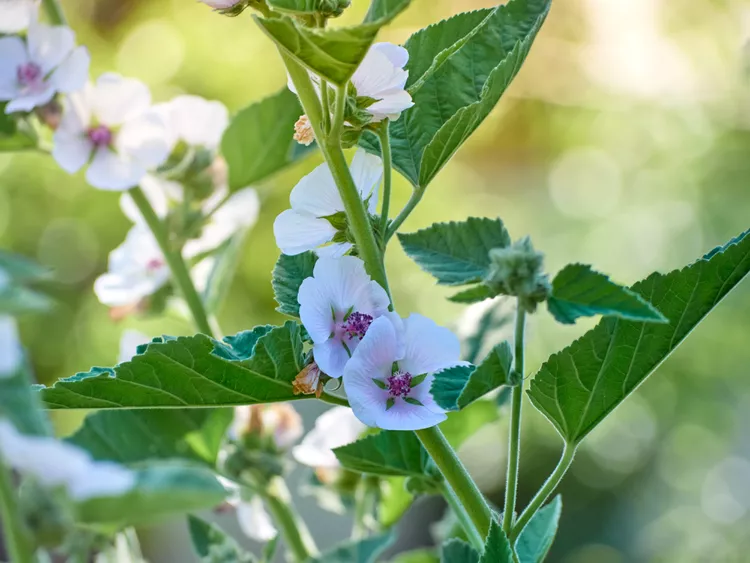
The velvety leaves and small hibiscus-like flowers of the marshmallow plant (Althaea officinalis) are a charming addition to any informal garden. Growing 4 to 6 feet tall with an upright habit, marshmallow serves as a handsome background plant for cottage gardens, herb gardens, mixed perennial beds, or rain gardens. Its white to pale pink blooms appear along the stems from mid-summer until early fall.
Ancient Egyptians and Romans used the roots of marshmallow plants to make a confection that was the forerunner of today’s marshmallows. However, the sweet white stuff you buy to make s’mores and marshmallow treats no longer contain any part of the plant; it is now grown primarily as an ornamental, although all parts of the plant are edible and contain a gummy mucilage that some cooks add to soups and stews for thickening.
Marshmallow Overview
| Genus Name | Althaea officinalis |
| Common Name | Marshmallow |
| Additional Common Names | Marsh Mallow |
| Plant Type | Perennial |
| Light | Sun |
| Height | 3 to 6 feet |
| Width | 2 to 4 feet |
| Flower Color | Pink, White |
| Foliage Color | Blue/Green |
| Season Features | Summer Bloom |
| Special Features | Attracts Birds, Low Maintenance |
| Zones | 3, 4, 5, 6, 7, 8, 9 |
| Propagation | Division, Seed |
Where to Plant Marshmallow
Grow marshmallow in any sunny garden where consistent soil moisture can be maintained. Less than six hours of direct sun results in fewer flowers. Choose an area with adequate moisture, especially while the plant establishes itself. It tolerates cold and can be grown in USDA Zones 3 to 9.
Because of the plant’s size and upright habit, place marshmallows toward the rear of mixed beds or the center of a circular bed. Its leaves have fine hairs on both the upper and lower surface, giving them a velvety texture; they serve as a foil for other colorful flowering plants. Marshmallow’s soft white or pale pink blooms combine easily with a wide variety of perennials. It is also a good choice for a rain garden where soils intermittently experience a lot of moisture. However, marshmallow doesn’t grow well in constantly standing water.
How and When to Plant Marshmallow
Sow marshmallow seeds outdoors in the fall or spring. Spring-sown seed requires a period of cold stratification (refrigeration for several weeks) to break its dormancy. Fall-sown seed doesn’t need refrigeration since it experiences cold temperatures outdoors. Plant four to five seeds together, spacing each group 24 to 30 inches apart. After the seedlings are several inches tall, remove all but the strongest from each group. For seeds started indoors, transplant them after the danger of frost has passed, spacing them 24 to 30 inches apart. Water seedlings consistently for the first growing season.
Marshmallow Plant Care Tips
Marshmallow can be found in its native regions (Central Asia and Western Europe) growing wild in wetlands, ditches, and streambanks, which offers a clue to its garden preferences.
Light
Marshmallow thrives in at least six hours of full sun per day. Less sun results in fewer flowers.
Soil and Water
While it is adaptable to soil types and pH, marshmallow does best in marshy soil. Fertile, moisture-retentive soil with good drainage is ideal. Add plenty of compost, shredded leaves, or other types of organic matter to the garden soil before planting to improve moisture retention and drainage. Mulching around the plant also helps retain soil moisture. Although the plant’s roots need consistent moisture, it does not do well when the roots are continuously submerged. Good drainage is essential. Well-established plants tolerate short periods of dry soil.
Temperature and Humidity
Marshmallow plants grow in a wide climate range (Zones 3-9) and are cold-tolerant. Excessive heat, particularly when combined with low humidity, can cause the plants to wilt.
Fertilizer
If you add organic matter to the soil before planting, no additional fertilizer is usually necessary. If you feel your plants need a boost, apply a small amount of a low-nitrogen organic fertilizer in spring or early summer. A dilute solution of a liquid fertilizer works well.
Pruning
Pruning is not usually necessary with marshmallows. Removing spent flowers keeps the plants looking their best. Plants die back to the ground in late fall or winter; remove the dead stems before new growth emerges in spring.
Pests and Problems
Few pests or diseases bother marshmallow plants, although flea beetles occasionally infest plants, causing small holes but minimal damage. If you have a severe infestation, use neem oil.
Marshmallows are closely related to hollyhocks and, like hollyhocks, are occasionally bothered by the fungal disease known as rust. The first signs of the disease are light-colored spots on the underside of lower leaves. The spots turn reddish-orange as spores form. Eventually, the spots turn black. Rust weakens plants and detracts from their appearance. To minimize damage from rust, remove any leaves that show signs of infection and any that fall to the ground. Avoid overhead watering. Copper fungicides are also effective for treating infected plants.
How to Propagate Marshmallow Plants
Marshmallow plants can be propagated by seed or division.
Seed
Marshmallow self-seeds unless the flowers are dead-headed. Volunteer seedlings appear near the mother plant; these can be dug up and replanted wherever you want them or shared with a gardening friend.
Seed propagation is the most common method of obtaining new marshmallow plants. The seeds are rarely carried in garden centers but are available online. Marshmallow seed requires a cold stratification period to break its dormancy and germinate. Seed that is sown in the fall receives the cold naturally. Sow the seeds directly in the garden where you want them to grow or in a prepared seed bed for transplanting into the garden in spring.
If you plan to plant seeds in spring, first place seeds in a plastic bag with some lightly moistened peat moss or sand and place the bag in the refrigerator for 40 to 60 days. After the cold stratification period is complete, sow the seed outdoors three to four weeks before the last frost date in your area.
You can also sow the seeds in pots filled with seed-starting mix. Cover them lightly with the mix, water them, and place them under grow lights, where they should germinate in about two weeks. After the plants grow several sets of leaves and the chance of frost has passed, gradually harden off the seedlings and then plant them in the garden.
Division
Marshmallow plants can be divided. Dig the plants in late fall or early spring before new growth appears. Since you might have removed the dead stems earlier, it’s best to dig plants for division in late fall when you can still see where they are.
Lift the entire root system of the plant. Using a sharp spade, cut it into sections. Replant each section, water well, and apply a 2- to 4-inch layer of mulch around the plants.
Marshmallow Companion Plants
Marshmallow plants prefer a sunny garden location where the soil stays consistently moist, so combining them with perennials that complement this growth habit and thrive in similar conditions is best.
Ranunculus
Several species and varieties of ranunculus (Ranunculus spp.) boast lovely flowers, usually with crepe-paper-like petals. Some are ground-hugging, while others are upright. The upright types bloom in spring and early summer. They are often sold in mixes with pink, white, magenta, and gold blooms that are great for cutting and show off well against marshmallow’s velvety green foliage. They're hardy in Zones 8-11; dig up the corms in colder areas and replant in spring.
Turtlehead
Turtlehead (Chelone lyonia) is a clump-forming perennial that grows 2 to 4 feet tall and bears two-lipped snapdragon-like flowers in late summer and into fall. Its flower seasoning and color work well with marshmallow. Turtlehead is native to the southeastern United States, and hardy in Zones 3-9.
Swamp Milkweed
Swamp milkweed (Asclepias incarnata) is another North American native. It grows 3 to 4 feet tall and bears fragrant pink, mauve, or white flowers in terminal clusters from mid to late summer. Its flowers attract butterflies and hummingbirds, and its leaves serve as food for the larvae of monarch butterflies. It's hardy in Zones 3-9.