
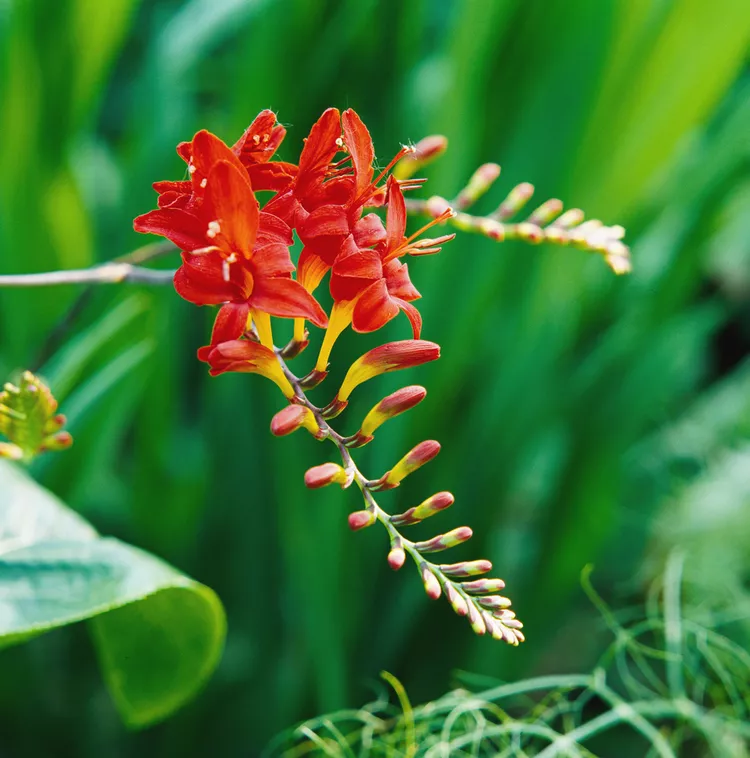
The graceful arching stems of crocosmia with petite red, orange, and yellow flowers are beacons to hummingbirds in search of a nectar-rich meal. These easy-to-grow corms (a bulb-like structure) unfurl their fiery flowers in midsummer and fall when the rest of the garden is often languishing in the heat. If you live in Zone 6 or above, you can count on crocosmia, also called montbretia, to add a burst of color and whimsical interest year after year. In all other climates, crocosmia can be grown as an annual. Some nurseries stock small crocosmia plants in nursery pots but the greatest selection of crocosmia cultivars is usually available as corms.
Crocosmia Overview
| Genus Name | Crocosmia spp. |
| Common Name | Crocosmia |
| Additional Common Names | Montbretia |
| Plant Type | Bulb |
| Light | Sun |
| Height | 2 to 4 feet |
| Width | 1 to 2 feet |
| Flower Color | Green, Orange, Red, Yellow |
| Foliage Color | Blue/Green |
| Season Features | Summer Bloom |
| Special Features | Attracts Birds, Cut Flowers, Good for Containers, Low Maintenance |
| Zones | 10, 6, 7, 8, 9 |
| Propagation | Division |
| Problem Solvers | Deer Resistant, Drought Tolerant, Good For Privacy |
Where to Plant Crocosmia
For crocosmia to thrive, pick a location in full sun and well-drained, slightly acidic soil.
The sword-shaped leaves and thin, arching stems of the plant offer great contrast to other garden plants in beds and containers. Plant a clump of crocosmia alongside other boldly colored late-summer bloomers such as black-eyed Susan, coreopsis, dahlia, and blanket flower. It is also very attractive when planted with contrasting color companions (see below). For the best bloom show, plant crocosmia in groups of at least a dozen.
How and When to Plant Crocosmia
The corms of crocosmia can be planted in the spring or fall. When planted in spring, they may not bloom until the following year.
Plant crocosmia corms 3 to 5 inches deep and 6 to 8 inches apart. Prior to planting, you may need to enrich the soil by incorporating a 2-inch layer of well-decomposed compost. For quick, easy planting, place a dozen or more corms of the same cultivar in a trench.
Crocosmia Care Tips
Other than providing it with enough water, it does not require much effort to grow crocosmia.
Light
Crocosmia blooms best in full sun; partial shade affects the bloom. The only exception is if you live in a hot climate, where the plant benefits from some afternoon shade.
Soil and Water
The plant is not finicky about the soil as long as it is well-drained, preferably with a pH between 6.5 and 7.5.
Keeping the plant moist is necessary, so, in the absence of rain, water accordingly, but don't overwater it.
Temperature and Humidity
Crocosmia is native to South Africa, where the climate is mild and dry, but the plant tolerates high heat and humidity. It is not winter-hardy below Zone 6. In a cooler climate, grow it as an annual or dig up the corms in the fall and store them in a cool, dry place over the winter, similar to overwintering gladiolus.
Fertilizer
There is no need to fertilize crocosmia, in fact, too many soil nutrients can lead to lots of foliage but no flowers.
Pruning
For a neater appearance, you can remove spent flower stalks. The foliage, however, should remain on the plant until it dies back naturally. Like other plants with corms and bulbs, green foliage helps the plant store energy for the next year’s bloom.
Potting and Repotting Crocosmia
Crocosmia can be grown in pots. Make sure they have large drainage holes and use well-draining potting mix.
Even if your climate is suitable for crocosmia to be grown as a perennial, at the cooler end of the plant’s zone spectrum, growing crocosmia in containers is not ideal. In pots, the plants are exposed to the winter cold (unlike in garden soil) and the freeze-and-thaw cycle can harm the corms to the point of killing the plant.
Repot crocosmia when the corms have filled the pot. You can either transplant it in a larger pot with fresh potting mix or divide it to relieve overcrowding.
Pests and Problems
Besides spider mites, which are a common pest of crocosmia, the plant does not have major pest problems. It is deer-resistant.
Overwatering can lead to root rot. One way of preventing this is to make sure the soil has excellent drainage.
How to Propagate Crocosmia
Crocosmia is known for its ability to multiply quickly by producing small offsets on the corms. Dividing the corms every three or four years is not only the best way to propagate crocosmia, it is also a way of rejuvenating a crowded plant. In the spring, just before the new growth starts, dig up the corms and gently separate them by hand. Discard any diseased or shriveled corms and replant the remainder in a new location at the same depth as the original plant, spacing the corms 6 to 8 inches apart.
Types of Crocosmia
'Ember Glow' Crocosmia
Crocosmia x crocosmiiflora 'Ember Glow' has vibrant upward-facing scarlet flowers that open wide to reveal golden throats. Zones 6-9
'Lucifer' Crocosmia
'Lucifer' (Crocosmia x Curtonus) is another hybrid that offers arching spikes of scarlet flowers in mid- to late summer. It grows 3 to 4 feet tall and is more winter-hardy than the species. Zones 5-9
'Meteore' Crocosmia
Crocosmia 'Meterore' bears bright yellow-orange blooms with red throats. It grows 3 feet tall. Zones 6-10
Companion Plants
Aster
Easy-to-grow asters come in a variety of shapes and sizes to suit gardens of all dimensions, shapes, and styles. A few species bloom in early spring but most varieties put on a spectacular flower display from late summer well into fall when other summer blooms are fading. Zone 3-9
Flowering Tobacco
Flowering tobacco plants have long been prized in cottage and moon gardens for their intensely scented flowers. A relative of true tobacco, flowering tobacco plants are grown for their blooms, adding splashes of color and scent all season long. The plant is a botanically a perennial grown as an annual in most places. Zone 10-11
Globe Thistle
Globe thistles are perennials with composite blooms—or large flower heads composed of smaller flowers grouped together to resemble a single blossom. When fully open, globe thistle blossoms are magnets for pollinators. Globe thistles make dramatic centerpieces in garden beds and add height to the back of border gardens and tolerate poor soil conditions. Zone 3-10