
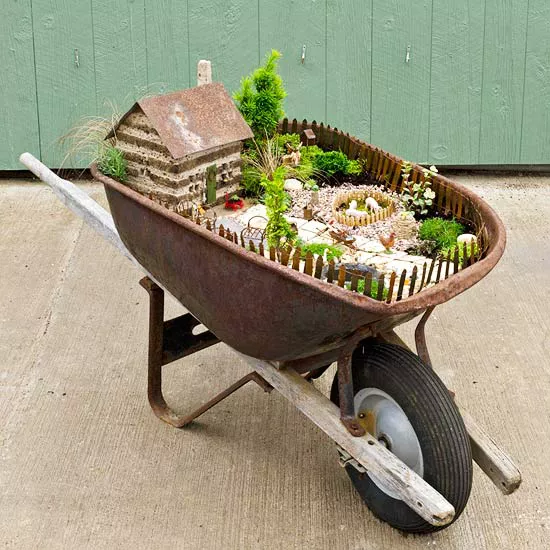
Create a charming miniature landscape in a vintage wheelbarrow that you can move about to suit your mood or lifestyle. This guide will walk you through how to make a fairy garden and select fairy garden plants and garden accessories. Plus it includes clever fairy garden ideas.
When she was young, Lou Killilea discovered enchanting worlds in her shoebox dollhouses. Now a grown woman, Killilea still finds magic in miniatures, especially miniature landscapes. At deMonye's Greenhouse in Columbus, Ohio, she teaches all ages—from children to grandparents—how to design these small worlds filled with acorn-size furniture, dwarf plants, and a guardian fairy or two. "People just love miniatures," Killilea says. "They bring out the kid in all of us."
Killilea collaborated with her daughter and granddaughter to create a charming farmhouse fairy garden in a vintage wheelbarrow. Follow their ideas or explore your own—perhaps a sports theme to honor a favorite team, a setting from a fun movie such as The Wizard of Oz, or a replica of a favorite travel destination such as an English garden or a Tuscan village. This wheelbarrow garden grows best in a sunny spot with afternoon shade, but it can be wheeled to a front porch or entrance to welcome guests or moved to a patio to serve as a party conversation piece.
Follow these easy step-by-step instructions to create your own fairy garden.
Gather Supplies
- Vintage wheelbarrow
- Medium-size pea gravel or river rock
- A piece of screen material cut to fit the bottom of the wheelbarrow
- Potting soil
Miniature furnishings: Purchase furnishings, accessories, and figurines—especially garden fairies—from garden centers, crafts stores, or online suppliers. Fairy garden kits are also available. Or, make your own, shaping items from clay or assembling household items and natural materials (think a marble-topped golf tee for a gazing ball or an acorn for an iconic fairy cap).
Scale is important because you're working in inches versus feet; here, Killilea begins with a 12x16-inch log cabin, then combines furnishings and accessories on a similar scale. She also uses a metal exterior fence, a wooden barnyard fence, farm animals, twig furniture, garden tools, a mini wheelbarrow, a tiny red wagon, a beehive, a birdbath, and a fairy figurine.
Hardscapes: For Killilea's miniature house, she chose one large ceramic tile, slightly larger than the base of the house; one or two sheets of mosaic stone tile with mesh backing; miniature pea gravel, mixed or solid colors; and a piece of slate.
Tip: To create a miniature pond, use a small glass dish, a blue glazed saucer, or a relic ashtray.
Select Fairy Garden Plants
These pint-size fairy garden plants grow best in a sunny morning spot with some afternoon shade. If there's no shade, Killilea says to stick with sun-loving succulents, annuals, and herbs. Below are several she suggests for their slower growing habits, Lilliputian forms, and copycat looks of larger plants. Envision Irish moss as turf, hens and chicks as shrubs, or even fiber-optic grasses as larger ornamental ones.
Sun-loving succulents: hens and chicks (Sempervivum), coral carpet stonecrop (Sedum album 'Coral Carpet'), large red carpet stonecrop (Crassula radicans), two-row stonecrop (Sedum spurium 'Dragon's Blood'), ice plant (Delosperma 'Table Mountain'), golden moss (Sedum acre), Echeveria 'Perle Von Nurnberg', zebra haworthia (Haworthia fasciata)
Dainty herbs: lavender (Lavandula angustifolia 'Hidcote'), lemon thyme (Thymus x citriodorus), woolly thyme (Thymus pseudolanuginosus), creeping thyme (Thymus serpyllum), creeping chamomile (Chamaemelum nobile)
Dwarf alpine trees: dwarf white cedar (Chamaecyparis thyoides 'Top Point'), dwarf golden yew (Taxus baccata 'Standishii'), dwarf Western red cedar (Thuja plicata 'Grune Kugel'), dwarf Sawara cypress (Chamaecyparis pisifera 'Dwarf Blue'), dwarf Japanese Hinoki cypress (Chamaecyparis obtusa 'Hage')
Ornamental grasses: fiber-optic grass (Scirpus cernuus), toffee twist sedge (Carex flagellifera 'Toffee Twist'), sea thrift (Armeria maritima)
Creeping groundcovers: bugleweed (Ajuga reptans 'Burgundy Glow' or 'Chocolate Chip'), golden creeping Jenny (Lysimachia nummularia 'Aurea'), creeping wire vine (Muehlenbeckia axillaris), miniature brass buttons (Leptinella gruveri), Irish moss (Sagina subulata), Scotch moss (Sagina subulata 'Aurea'), creeping speedwell (Veronica repens), saxifrage (Saxifraga 'Purple Robe')
Foliage favorites: Oxalis 'Charmed Wine', My Monet Weigela 'Verweig', white clover (Trifolium repens 'Atropurpureum'), dwarf lady's mantle (Alchemilla erythropoda), miniature hostas
Fairy flowers: bellflower (Campanula carpatica 'Pearl Deep Blue'), Cuphea 'Mellow Yellow', basket of gold (Aurinia saxatilis), miniature mat daisy (Bellium minutum)
Tip: Ask your nursery staff for "plug-size" plants or divide larger ones to "Thumbelina" scale.
Prepare the Wheelbarrow
In the bottom of the wheelbarrow, drill five to seven holes for drainage to prevent your plants' roots from rotting in soggy soil.
Add Drainage Pebbles
Cover the bottom of the wheelbarrow with screen to contain the soil and then fill the base with a layer of medium-size pea gravel or river rock.
Add Soil
Fill the wheelbarrow with quality potting soil. Killilea fills it nearly full, knowing the soil will settle after it's watered.
Add Water
Thoroughly soak the soil with water. Then allow the water to drain and the soil to settle.
Level the Soil Surface
Gently pack the soil with your hands or a shovel and smooth the surface.
Position the House
Form a base for the house by placing a square tile near the back of the wheelbarrow. Position the house for your fairy garden atop the tile.
Add a Stone Walkway
Use scissors to cut strips of tile from mosaic stone tile sheets. Killilea lays a double set of strips to mark a gently curving central path from the wheelbarrow's edge to the log cabin's front door.
Add Large Plants
Add fairy garden plants, applying full-scale landscaping rules: Begin with larger plants; then fill in spaces with smaller ones. Here, Killilea plants a dwarf cypress, a small juniper, and a miniature pine.
Install a Perimeter Fence
Create an attractive border with a ready-made exterior fence or a homemade chicken wire version. To secure the fence, bury its base along the inside edge of the wheelbarrow.
Design Hardscape Features
Picture living and working spaces for your miniature landscape, then create them. Here, Killilea designs an outdoor patio complete with a cozy fire pit as a fairy garden accessory. She also installs a circular livestock pen with a picket fence; you can purchase one or make your own with wooden stir sticks. Killilea completes her pen with miniature farm animals and a pasture of moss sheeting. Finally, she adds a third feature—a shallow marble saucer to serve as a pond. A glass dish, an ashtray, or a blue glazed saucer also works. To keep the pond water clean, wait until the planting is finished before adding the water.
Fill Spaces with Smaller Plants
Use smaller plants to soften the edges of the house, path, patio, and pond. Allow space for growth, or plan to periodically trim the plants. Killilea often cuts small potted plants into four or five smaller ones.
Cover Bare Soil with Moss and Gravel
Hide any exposed soil with live moss or miniature pea gravel in solid colors or a mix. Use a scoop, a spoon, or your fingers to apply the gravel in tight spots.
Finish with Accessories
Have fun accessorizing your space. Just remember to be consistent with scale and keep the scene in real-life proportions. You also can update the wheelbarrow design with seasonal embellishments—spring lambs and ducklings, summer garden produce, and fall pumpkins or scarecrows.
Tip: Use a paintbrush as a broom to sweep dirt from the patio or path.
Care for Your Miniature Landscape
Keep the soil moist to the touch but not soaking wet. To water, use a small watering can rather than a powerful spray hose that can wash away small materials. Killilea thoroughly waters her landscape once a week. She also trims plants when they overgrow their spaces.